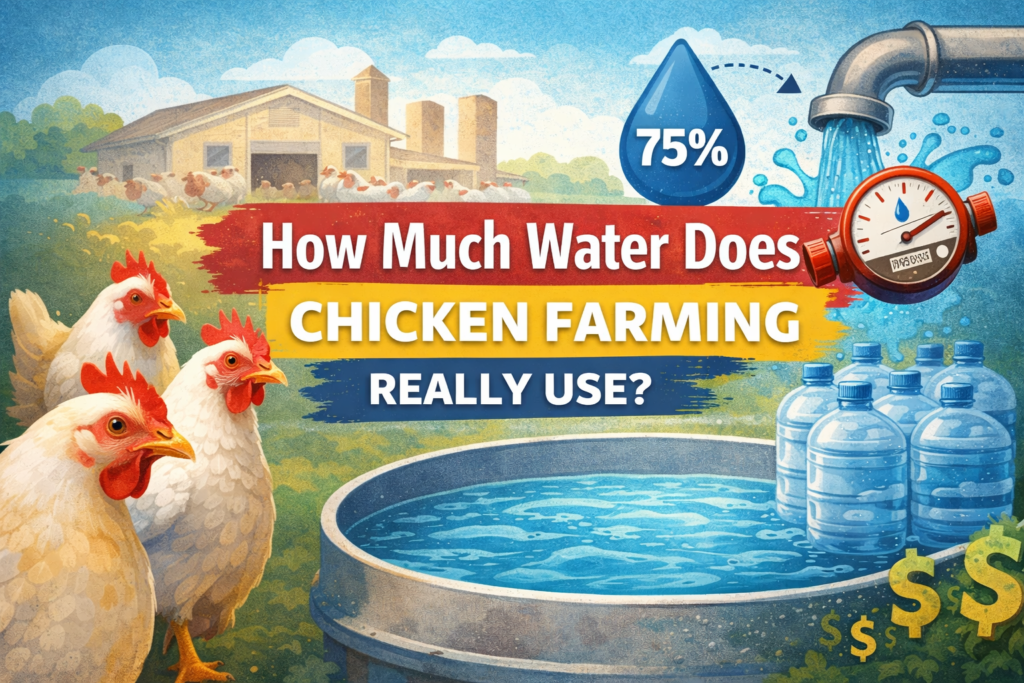
Sustainability-conscious consumers often focus heavily on carbon emissions but tend to overlook the substantial water use involved in animal agriculture. This is applicable to even poultry, and in the case of other livestock, it is even worse. With increasing water scarcity worldwide, it is important to know how much water does chicken farming use. Per our secondary research, the water footprint of chicken farming is much higher than thought.
Global droughts, groundwater decline, and environmental concerns are pushing consumers toward cleaner, greener options like vegetarian chicken substitutes. Companies like Greenmeat, a revolutionary plant-based protein product from India, showcase how sustainable eating drastically reduces water use and environmental strain.
Why Water Usage in Chicken Farming Matters Today
Water shortage is becoming a global crisis. Agriculture utilizes about 70% of the world’s freshwater, and poultry farming comprises a great deal of the consumption. While water usage in chicken farming may appear relatively low compared with beef, pork, etc, billions of liters are still used along the entire value chain.
Eco-conscious consumers are increasingly choosing sustainable protein alternatives like vegetarian meat substitutes. Such options greatly reduce chicken farming water consumption and are thus smarter, greener choices.
Global Freshwater Crisis – The Big Picture
According to the FAO and UN statistics, freshwater depletion is accelerating because of a rise in population demands and climate change. This means that industries dependent on high water usag – namely, animal agriculture – are placing even more pressure on the dwindling reserves. With water scarcity affecting several regions worldwide, efficient water use in food production has become a global priority
To understand this, one needs to know about three categories of water:
- Blue Water: Groundwater and surface water used for irrigation and processing.
- Green Water: Rainwater stored in soil that crops absorb.
- Grey Water: Water required to absorb and neutralize pollutants.
Why Animal Agriculture Is a Major Water Consumer
Animal agriculture uses water not just to quench animals’ thirst. Unseen layers come into play, which drastically increase its total impact: huge volumes of water go into feed production, farm sanitation, and meat processing.
Compared with plant-based systems, animal farming — poultry included — is still a very resource-intensive endeavor. Chicken has a lower footprint than beef, but it contributes noticeably to global freshwater demand and climate change, and leads to environmental degradations.
Breaking Down the Water Footprint of Chicken Farming
Our findings indicate that, in poultry farming, water footprints accrue in several stages of the production chain, from feed to processing, often in surprisingly large quantities.
Water Used for Growing Chicken Feed (The Largest Portion)
Most of the water utilized in poultry farming goes into the production of feed crops such as soy, corn, and grains. These crops require extensive irrigation alone, accounting for 65–80% of total water use. Just to grow feed for commercial poultry operations, millions of liters are used.
Besides this, feed-to-meat conversion is inefficient. To get 1 kg of meat, chickens need to eat many kilograms of feed, multiplying overall water usage. This makes feed production the biggest contributor to chicken farming water consumption.
Drinking Water for Chickens
Chickens drink between 200–400 ml of water per day, which seems small but becomes significant when multiplied across billions of birds raised annually. Broiler houses need continuous delivery of fresh drinking water, especially in hot climates like the Middle East. This constant supply adds substantial pressure on local water systems.
Large-scale poultry operations do have automated watering systems that are in need of constant replenishment. In fact, with drinking water alone, poultry operations worldwide use millions of liters each day.
Water Used in Housing, Washing & Sanitization
Cleanliness in the housing environment is also crucial for the health and biosecurity of poultry. Farmers use water in shed cleaning, waste flushing, and cooling systems. Daily sanitation is required to prevent disease outbreaks; therefore, water usage never stops.
Cooling systems can use vast quantities of water, particularly in hot regions. Evaporative coolers and misting systems also work for hours on end and further increase the total footprint.
Water for Slaughtering & Processing
Thousands of liters of water are used by poultry processing plants in one hour. Scalding, defeathering, carcass washing, and chilling systems all require water. These operations cannot be reduced, as hygiene standards are very high.
Water used at the processing plant also has to carry the additional load of wastewater treatment, making it one of the most water-intensive stages in the poultry supply chain.
How Much Water Does It Really Take to Produce 1 kg of Chicken?
Several global studies have measured the complete water footprint of poultry. The results reveal surprisingly high figures, highlighting the hidden impact behind every kilogram of chicken meat. These estimates account not only for direct water used on the farm, but also for the embedded virtual water in feed production, processing, and transportation. In many regions, the environmental cost of water for chicken far exceeds what consumers assume, especially when considering water scarcity and competing agricultural demands.
Water Footprint Network Estimates
The global average water footprint for chicken meat is approximately 4,300 liters per 1 kg, according to the Water Footprint Network. This accounts for all blue, green, and grey water in all phases of production. Numbers in highly irrigated regions, such as India and Brazil, are even higher.
Different countries show different water footprints based on their climates and agricultural methods. For instance, the US and Europe generally have more efficient irrigation systems but still use thousands of liters per kilogram of chicken.
Comparison with Other Animal Proteins
Compared with beef, chicken seems more water-friendly — but it still has a large footprint. Beef uses roughly 15,000 liters per kilogram, while pork uses about 6,000 liters. Chicken stands at 4,300 liters and is lower, but still notably higher than plant-based proteins. Fish generally tends to have a lower footprint but varies quite a bit by species and farming method.
These comparisons show that chicken, despite being marketed as “better,” still has a high water footprint.
The Hidden "Virtual Water" Behind Chicken Farming
Virtual water means indirect water usage throughout the entire value chain of poultry. This also encompasses such aspects as the production of fertilizers, generation of electricity, transportation, and packaging-all the hidden water costs that add up to true environmental footprint, yet which hardly get discussed.
Virtual water also includes the water that is embedded in imported feed ingredients. Countries which import soy are indirectly importing the water used to grow it abroad.
Environmental Consequences of High Water Use in Chicken Farming
High water consumption in poultry farming causes several environmental problems. These effects reach much farther beyond the farms themselves to include ecosystems, communities, and future water supplies. Over time, excessive water extraction can weaken natural waterways and reduce their ability to support wildlife. This strain on local water systems also increases competition for clean water among farmers, households, and industries, worsening long-term sustainability challenges.
Depletion of Groundwater Resources
Irrigation for feed crops is heavily drawn from groundwater aquifers. In countries like India, the US, and Brazil, water tables are dropping dramatically due to over-extraction, creating long-term sustainability risks and threatening future food production.
Aquifer depletion also harms surrounding communities depending on the groundwater for drinking and agriculture. Recovery can take decades once levels fall too low.
Water Pollution from Poultry Waste Runoff
Poultry farms produce huge amounts of waste, which often contain antibiotics, pathogens, nitrates, and phosphates. When these wastes reach rivers and streams, they cause heavy pollution. This leads to eutrophication that kills fish and thereby destroys the ecosystem.
The most important effects on the local community, regarding public health, include reduced access to clean water due to contaminated water. Pollution remains one of those environmental costs that hardly appear in mainstream reports.
Deforestation Driven by Feed Production
Much of the soy used for poultry feed is connected to deforestation in places such as the Amazon. The clearing of forests for feed crops is detrimental to biodiversity and leads to climate change. This global issue is directly influenced by rising demand for chicken meat.
Deforestation disrupts water cycles, which further exacerbates water scarcity in such regions.
Carbon + Water Nexus
Water-intensive farming systems use more energy, adding to the greenhouse gas contribution. In other words, the cycle goes: increased water use with increased carbon impact, and with climate change comes increased water scarcity. The carbon-water nexus increases stress on global sustainability.
Chicken Farming vs. Plant-Based Meat: Which Uses Less Water?
Plant-based proteins significantly outperform chicken when it comes to water efficiency. Choosing plant-based options leads to measurable reductions in water impact. These alternatives eliminate the need for water-heavy feed crops and animal processing, dramatically shrinking the overall footprint. As more consumers adopt plant-based choices, the cumulative savings in global water resources can become substantial.
Water Footprint of Plant-Based Proteins
Compared to chicken, plant-based meats use between 70-95% less water. Most vegetarian proteins require only 300-500 liters per kilogram, whereas chicken requires 4,300 liters per kilogram. This would make plant-based proteins among the top alternatives in terms of sustainability.
The major difference arises due to the exclusion of feed irrigation and animal processing systems.
Why Plant-Based Meat Requires Far Less Water
Plant-based meat requires fewer resources because plants produce food directly by converting sunlight, rather than having to convert feed to food. This decreases the total amount of water used significantly. Plant-based processing uses far less water compared to slaughterhouses.
Greenmeat, a leading plant protein based food manufacturer, relies on eco-conscious ingredients such as peas, soy, vegetables, and spices. Its manufacturing system incorporates water-saving processes and recycling methods, making it a model for sustainable food production.
Hidden Water Costs the Industry Doesn’t Talk About
Many water costs remain invisible to the average consumer. These hidden burdens contribute to the overall environmental impact of poultry farming.
Antibiotics and Chemical Inputs
Antibiotics utilized in poultry farming eventually end up in the water bodies through runoff and waste disposal, causing contamination of water that again creates risks to human health and ecosystems. Chemical fertilizers in feed production add to the extent of water pollution.
Energy-Water Interdependency
The poultry farm sector is very dependent on electricity for cooling, lighting, and automation. Electric generation, especially at thermal facilities, depends greatly on water. This already adds considerable amounts indirectly to the chicken farming water footprint.
Packaging and Transportation Water Footprint
Plastic packaging, refrigerated vehicles, and long supply chains all have manufacturing and operational uses of water. These water costs are seldom reflected in official calculations but raise the environmental footprint considerably.
The Future: Can the World Sustain Chicken Farming’s Water Demand?
With the rise in population and protein demand, sustaining such water-intensive systems becomes quite difficult. The future of food production globally depends on more efficient and sustainable practices being adopted.
Rising Global Population & Protein Demand
Global population growth by the year 2030 will tremendously increase the demand for protein. Meeting this with water-heavy animal agriculture will impose great pressure on freshwater resources, potentially pushing global food systems past their limits.
Sustainability Policies & Water Regulations
Due to this fact, governments of different parts of the world are issuing strict policies for agricultural water usage in order to minimize wastage and encourage sustainable farming. Compliance will require major changes from poultry producers.
Why Shifting to Plant-Based Diets Helps Preserve Water Resources
International bodies like the IPCC recommend that plant-based diets should be increased in order to reduce the pressure on water systems. Plant-based proteins offer a sustainable solution that supports environmental conservation. They represent the future of eco-friendly eating.
How Consumers Can Reduce Their Water Footprint Through Food Choices
Every individual has the power to reduce water consumption by making mindful food choices. Small changes can add up to make a big difference globally.
Opting for Water-Efficient Proteins
Choosing plant-based proteins and vegetarian chicken alternatives can dramatically reduce personal water footprints. Not only is this choice healthier for the planet, but equally as tasty.
Supporting Brands with Transparent Sustainability Practices
Consumers should favor those brands which clearly identify their sourcing practices, certifications, and sustainability objectives. Such transparency in companies ensures an easier way to make environmentally responsible choices.
Reducing Food Waste
Food waste indirectly wastes all the water used in its production. By reducing waste, consumers can significantly decrease their overall water footprint. Planning meals and storing food properly helps minimize household waste.
Leftover ingredients can be creatively repurposed instead of being discarded. Small actions accumulate into significant environmental savings. Reducing wastage is one of the easiest ways to protect freshwater resources.
Conclusion: Reducing the Water Footprint with Smarter Protein Choices
Reducing your environmental impact starts with understanding how much water does chicken farming use, a number that reveals just how resource-intensive poultry production truly is. The significant water usage in chicken farming highlights why consumers are increasingly looking for more sustainable protein options. Embracing a plant-based lifestyle is a powerful way to lower your personal water footprint while supporting sustainable eating. Eco-conscious individuals can make this shift seamlessly with Greenmeat’s Vegetarian chicken substitutes, which deliver the flavors you love with far less environmental strain. These water-efficient alternatives demonstrate that plant-based choices can be both satisfying and responsible.
Get in Touch Today with Greenmeat and start enjoying delicious, sustainable, and innovative protein solutions that empower you to make a meaningful difference every single day.